
Results of the CINTEM project
This page contains links to articles, theses and other publications related to the results of the CINTEM project.
Materia 4/2025
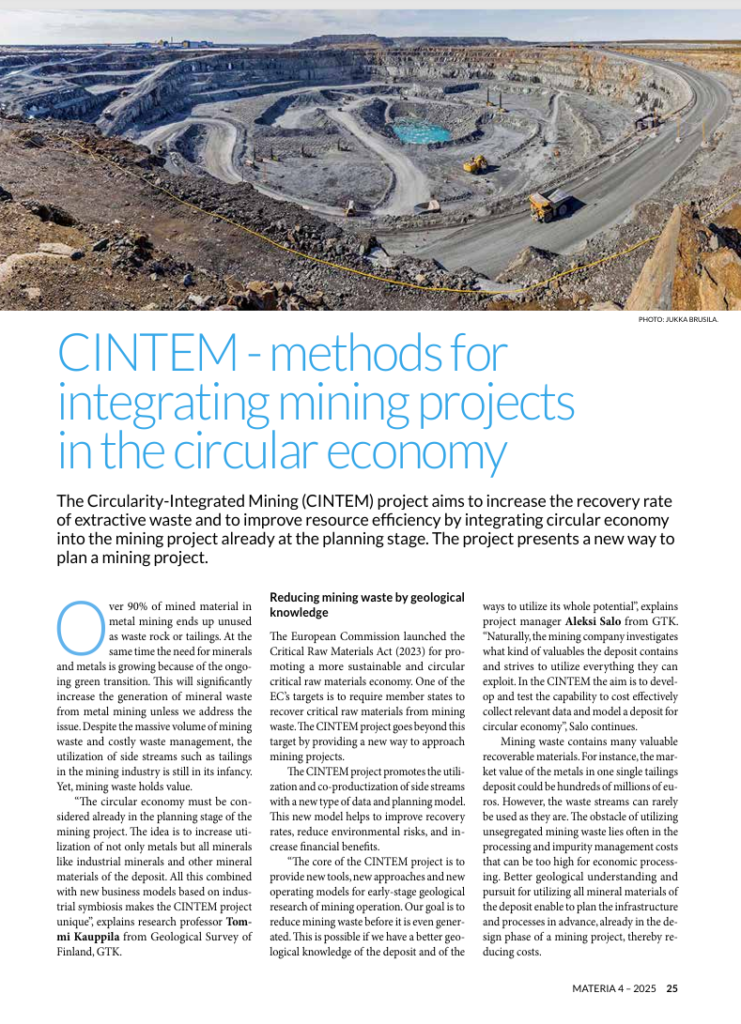
The Article describes the CINTEM project, which seeks to integrate circular economy principles into mining project planning to reduce waste and improve the utilization of all mineral resources within a deposit. It explains how enhanced geological data, digital deposit models, and new approaches to resource characterization can support higher recovery rates, lower environmental impacts, and more efficient mining operations. It also highlights the development of industrial symbiosis-based business models and international collaboration aimed at creating more sustainable and economically viable mining ecosystems.
Reprocessing tailings to advance circular economy in mining (VTT)
Tailings reprocessing can reduce environmental liabilities while recovering metals and creating new business opportunities. Commercial viability depends on sufficient metal grades and holistic evaluation of metals, by-products, and bulk minerals. Although industry interest is growing, full-scale operations remain rare, constrained by limited knowledge of historical tailings and a continued focus on single target metals.
A circular economy framework for assessing minerals processing concept options (VTT)
This paper introduces a circular economy framework for evaluating minerals processing concepts that improve resource efficiency and reduce waste across mineral value chains. The framework supports holistic process design.
Exploring the potential of lithium tailings in construction materials, Minerals Engineering 233, 2025 (University of Oulu et al.)
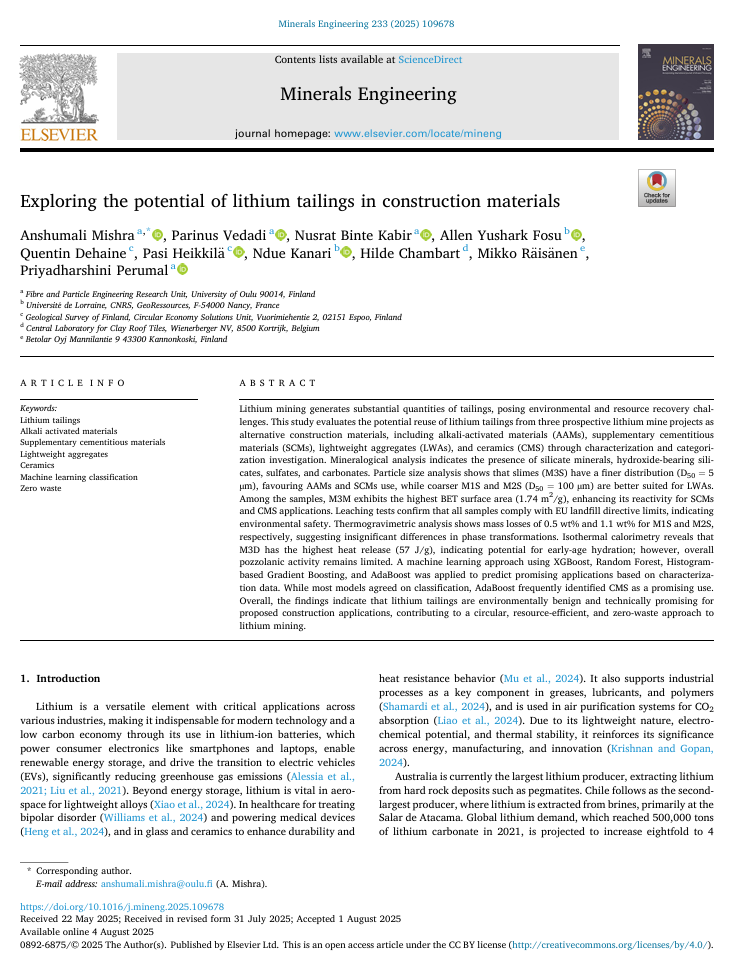
Could lithium mining waste become a valuable resource for sustainable construction? This study explores how lithium tailings can be transformed into construction materials, including ceramics, lightweight aggregates, and cement alternatives. By combining laboratory characterization with machine learning, in this research study, promising applications were identified while assessing environmental safety. The findings reveal opportunities to reduce mining waste, conserve natural resources, and advance circular construction practices.
The Economic and Environmental Motivations of Commercial Tailings Reprocessing for Added Value (VTT)
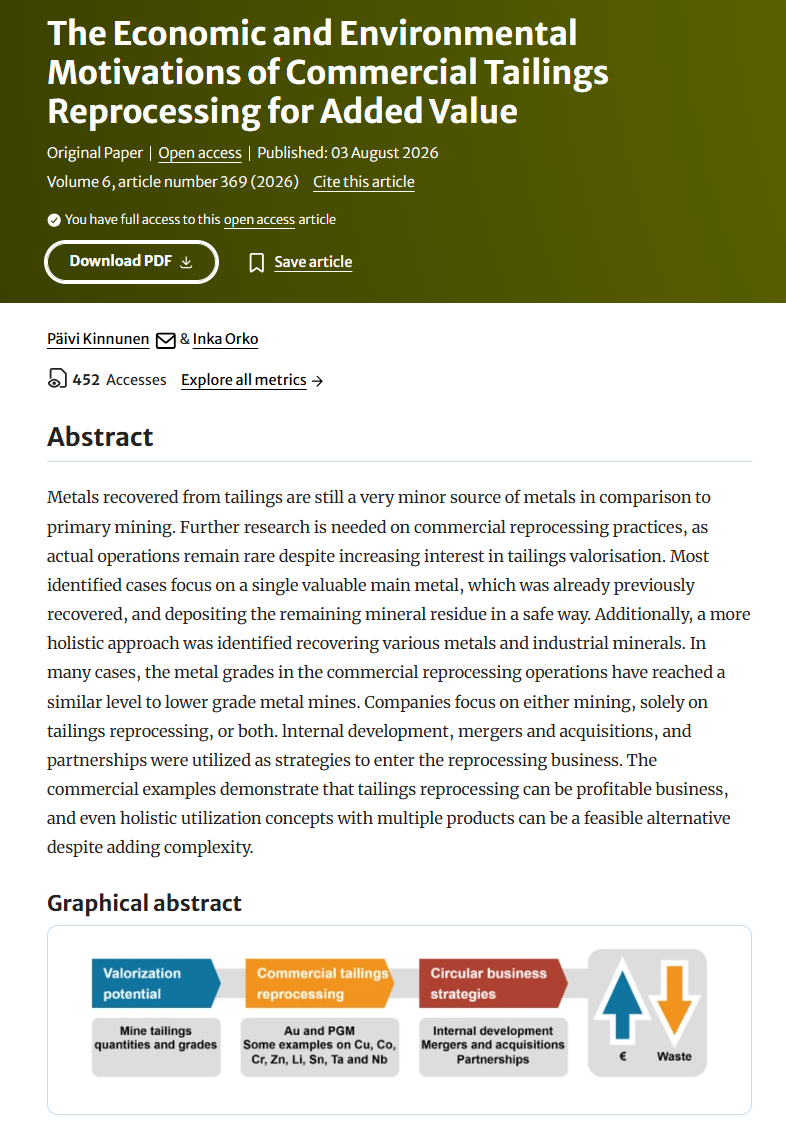
Tailings currently provide only a small share of metals compared with primary mining, and commercial reprocessing remains uncommon despite growing interest. Existing commercial operations typically recover one previously targeted metal, while some pursue other previously unrecovered metals and industrial minerals. Comparable grades to low-grade mines, and diverse business strategies demonstrate that reprocessing can be profitable.
Recovery of copper, manganese, nickel and cobalt from synthetic mine tailings leachate by ion exchange (LUT)
The thesis investigated ion-exchange recovery of copper, manganese, nickel, and cobalt from synthetic mine-tailings leachate using ion exchange. Three chelating resins selectively separated the metals: Purolite® S930Plus recovered copper (22 g Cu/L), Lewatit® MDS TP 260 separated manganese (2.5 g Mn/L), and Lewatit® MDS TP 220 separated nickel (15 g Ni/L). Resulting purities were 98.2% copper, 99.2% manganese, 99.5% nickel, and >99.9% cobalt.
Life cycle assessment of rare earths and niobium concentrate co-recovery from phosphate flotation tailings: case of a Finnish fluorapatite deposit (LUT)
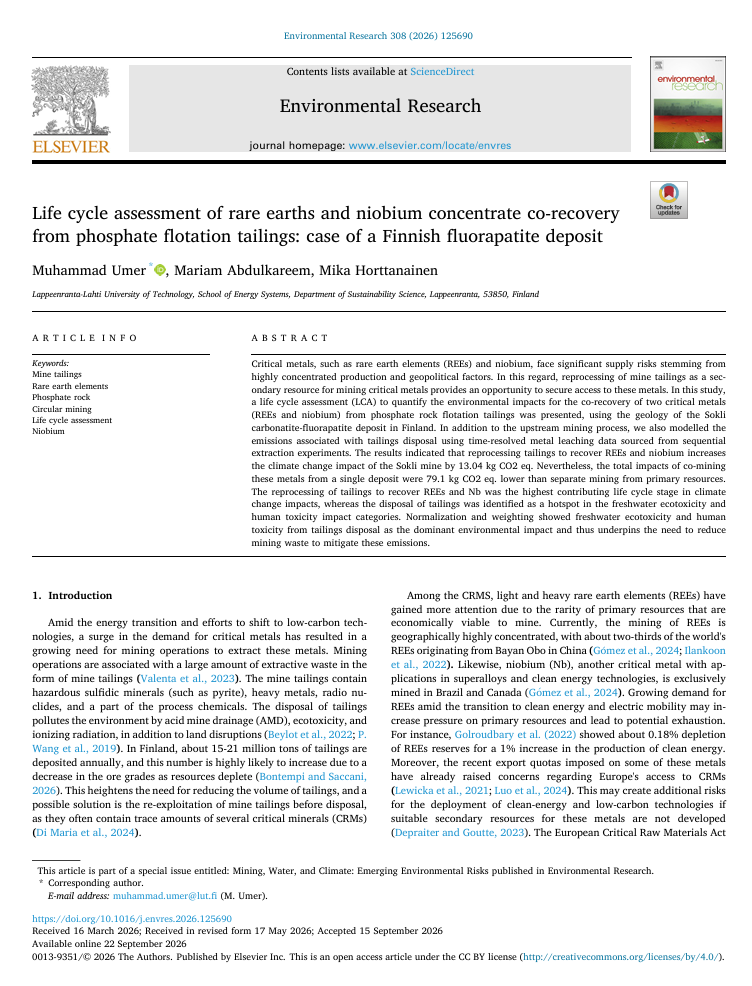
This study presents a life cycle assessment (LCA) of the co-recovery of rare earth elements (REEs) and niobium from phosphate rock flotation tailings, using the Sokli carbonatite-fluorapatite deposit in Finland as a case study. The assessment evaluates the environmental implications of recovering critical metals from mine tailings as secondary resources compared with conventional primary mining. The system boundary encompasses upstream mining operations, mineral processing, tailings reprocessing, and waste disposal. Additionally, time-resolved metal leaching data from sequential extraction experiments are incorporated to model emissions associated with tailings disposal, providing a comprehensive assessment of the environmental sustainability of circular mining practices.
Recovery of fine valuable minerals from Rautuvaara sulphide tailings using mechanical and pneumatic flotation cells (University of Oulu)
This thesis investigates the recovery of copper from historical Rautuvaara sulphide tailings, where resource utilization is challenged by ultra-low grades, fine particle size, oxidation, and complex mineralogy. The study evaluated mechanical and pneumatic flotation methods and found that flotation pre-concentration can provide an effective circular-economy approach for recovering copper from historical mine tailings for downstream processing.